


The Science of Positive and Negative Pressure in Plastic Forming
Plastic forming is fundamentally a controlled interaction between heat, pressure, material behavior, and tooling.
When a thermoplastic sheet is heated above its forming temperature, it becomes sufficiently soft to deform. At this stage, pressure differences can be used to move the material against a mould and create the required three-dimensional shape.
Two important approaches are positive pressure forming and negative pressure forming, commonly known as vacuum forming.
Although both processes use pressure differences to shape heated plastic, the way the force is generated is different. Understanding this difference helps engineers select the appropriate forming method, mould design, material and processing equipment.
For industrial manufacturers, pressure should not be considered independently. Forming temperature, sheet thickness, material properties, mould geometry, air evacuation and cooling all interact to determine the final part quality.
What Does Pressure Mean in Plastic Forming?
In plastic forming, pressure describes the force difference acting across the heated plastic sheet.
A simplified relationship can be expressed as:
Pressure force = Pressure difference × Effective area
This means that even when the absolute pressure is relatively low, a sufficiently large pressure difference acting over a large forming area can generate a significant forming force.
This principle is particularly important in thermoforming.
A typical thermoforming process begins with a flat thermoplastic sheet. The sheet is heated until it becomes flexible, positioned over or around a mould, and then formed by controlling the pressure on either side of the sheet.
Vacuum forming uses reduced pressure on one side of the sheet to create the pressure differential. Pressure forming uses compressed air to increase pressure on the opposite side.
In both cases, the objective is similar:
Move the heated plastic into close contact with the mould surface and allow it to cool while maintaining the required geometry.
Positive Pressure Forming: Using Compressed Air to Shape Plastic
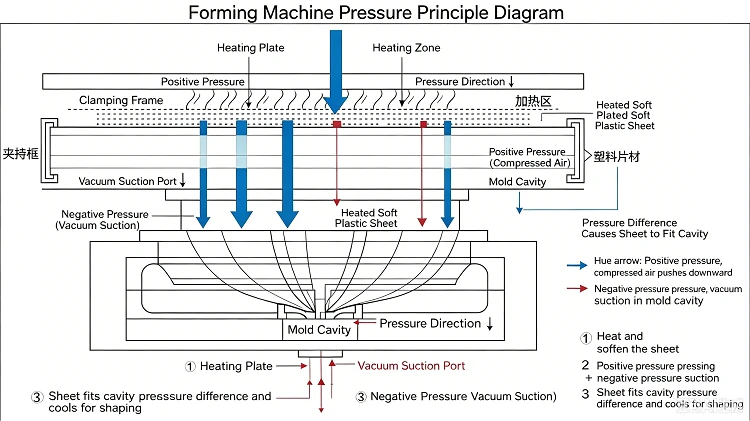
Positive pressure forming uses compressed air to push a heated plastic sheet toward the mould.
After the plastic sheet reaches the appropriate forming temperature, it is positioned over the mould. Compressed air is then introduced above the sheet, creating a pressure difference between the two sides.
The air pressure pushes the softened material against the mould surface.
Compared with basic vacuum forming, pressure forming can provide a stronger driving force and can be useful when the application requires more detailed surface reproduction.
The actual pressure required depends on several factors, including:
Plastic material
Sheet thickness
Forming temperature
Part geometry
Mould design
Required surface detail
Forming area
Cooling conditions
Pressure alone does not determine the quality of the formed component.
If the sheet is too cold, it may not deform uniformly. If it is too hot, excessive stretching or thinning can occur. Similarly, an unsuitable mould design can prevent the material from reaching certain areas even when sufficient pressure is available.
Therefore, positive pressure forming should be treated as a complete process rather than simply increasing air pressure.
Negative Pressure Forming: How Vacuum Forming Works
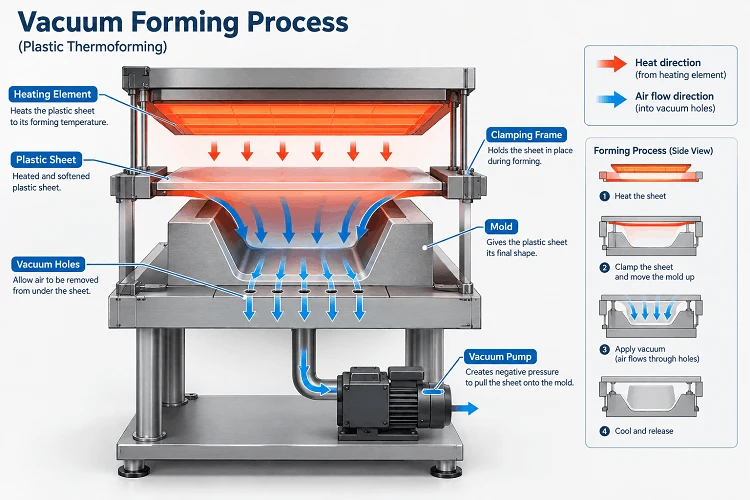
Negative pressure forming is commonly referred to as vacuum forming.
Instead of increasing the pressure above the plastic sheet, the forming system removes air between the heated sheet and the mould.
This creates a lower pressure region beneath the sheet.
Atmospheric pressure on the opposite side then pushes the softened plastic toward the mould.
A simplified sequence is:
Heat → Position → Evacuate air → Form → Cool → Release
Vacuum forming is widely used because it can produce large plastic components with relatively simple tooling.
The process generally uses lower forming pressures than pressure forming, which can allow comparatively economical mould construction for suitable applications.
However, vacuum forming is not simply a matter of applying the strongest possible vacuum.
The effectiveness of the process depends on how quickly and evenly the air can be removed from the forming area.
Mould venting therefore becomes an important engineering consideration.
If trapped air remains between the plastic sheet and the mould, the material may not reproduce the intended geometry correctly.
Positive vs. Negative Pressure in Plastic Forming
The basic difference can be summarized as follows:
| Factor | Positive Pressure Forming | Negative Pressure Forming |
|---|---|---|
| Main principle | Compressed air pushes the sheet | Vacuum removes air from the mould side |
| Common name | Pressure forming | Vacuum forming |
| Driving force | Increased pressure | Reduced pressure |
| Tooling | Usually requires suitable pressure-rated tooling | Can often use simpler tooling |
| Surface detail | Can be suitable for detailed forming | Suitable for many general thermoformed shapes |
| Air management | Controls compressed air and pressure | Requires effective vacuum and mould venting |
| Typical use | Detailed plastic components | Packaging, trays, covers and larger formed parts |
The selection should be based on the complete production requirement rather than the pressure method alone.
For example, a manufacturer producing a relatively simple packaging tray may have different tooling and equipment requirements from a manufacturer producing a detailed automotive interior component.
Why Pressure Difference Matters More Than Pressure Alone
One of the most important concepts in plastic forming is that the material responds to pressure difference, not simply to a pressure value considered in isolation.
Suppose the pressure above and below a heated sheet is nearly identical. The net force acting on the sheet will be relatively small.
When the pressure difference increases, the resulting force also increases.
A simplified expression is:
ΔP = P₁ − P₂
where:
ΔP = pressure difference
P₁ = pressure on one side of the sheet
P₂ = pressure on the opposite side
The forming force can then be approximated as:
F = ΔP × A
where:
F = forming force
A = effective forming area
This relationship helps explain why mould size and part geometry matter when evaluating a forming process.
A large forming area can require substantial overall force even when the pressure differential itself is relatively modest.
For production engineers, this is one reason why equipment selection should consider the complete forming area rather than looking only at the nominal vacuum or air-pressure specification.
How Material Temperature Affects Pressure Forming
Pressure cannot compensate for an unsuitable material temperature.
Thermoplastics become more formable as they are heated, but each material has its own processing window.
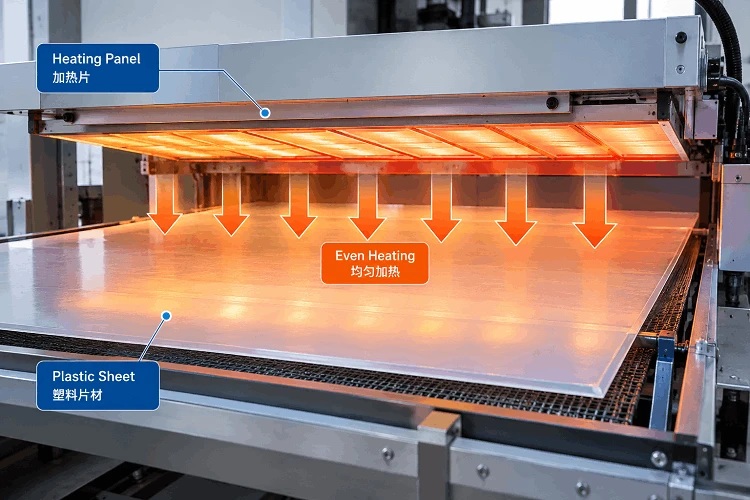
During thermoforming, engineers typically aim to heat the sheet sufficiently for controlled deformation while avoiding excessive overheating.
Temperature distribution across the sheet is particularly important.
If one area is significantly hotter than another, the softer region may stretch more easily. This can produce uneven wall thickness or dimensional variation.
Several factors can influence the final material distribution:
Initial sheet thickness
Plastic type
Heating temperature
Heating uniformity
Mould geometry
Forming speed
Pre-stretching
Cooling rate
For deep-draw components, controlling material distribution becomes particularly important.
A suitable forming process therefore combines temperature control and pressure control, rather than treating pressure as the only forming variable.
The Role of Mold Design and Air Venting
A well-designed mould is essential for both positive and negative pressure forming.
The mould determines the final geometry of the part, but it also affects how the plastic moves during forming.
Important considerations can include:
Draft Angles
Appropriate draft angles can make it easier to release the formed component from the mould.
Surface Finish
The mould surface can influence the appearance and surface quality of the formed plastic.
Venting
In vacuum forming, small venting paths allow trapped air to escape as the sheet is drawn toward the mould.
Poor venting can result in incomplete forming, air pockets or loss of detail.
Draw Depth
Deep cavities place greater demands on material stretching and thickness distribution.
Plug Assist
For certain geometries, a plug assist can help pre-stretch the heated sheet before the final forming stage.
The combination of mould geometry, material properties and forming conditions determines how evenly the plastic is distributed throughout the finished component.
Common Applications of Pressure-Based Plastic Forming
Pressure-based thermoforming is used across a wide range of industries.
Common applications include:
Plastic packaging
Food trays
Disposable containers
Protective covers
Electronic equipment housings
Automotive interior components
Medical and laboratory products
Industrial trays
Product prototypes
Custom plastic components
Vacuum forming is particularly useful for certain prototypes, low-volume parts and larger formed components because tooling can be relatively economical compared with some alternative manufacturing processes.
Material selection is also application-dependent.
Common thermoforming materials include ABS, HIPS, PETG, PVC and other thermoplastics, depending on the required mechanical, thermal, chemical and appearance properties.
From Plastic Forming to Die Cutting
Plastic forming and plastic die cutting are different manufacturing processes, but they can appear in the same production workflow.
A thermoforming process creates the three-dimensional plastic shape.
After forming, the excess material around the component may need to be removed. The formed plastic can then move to a secondary trimming or die-cutting process.
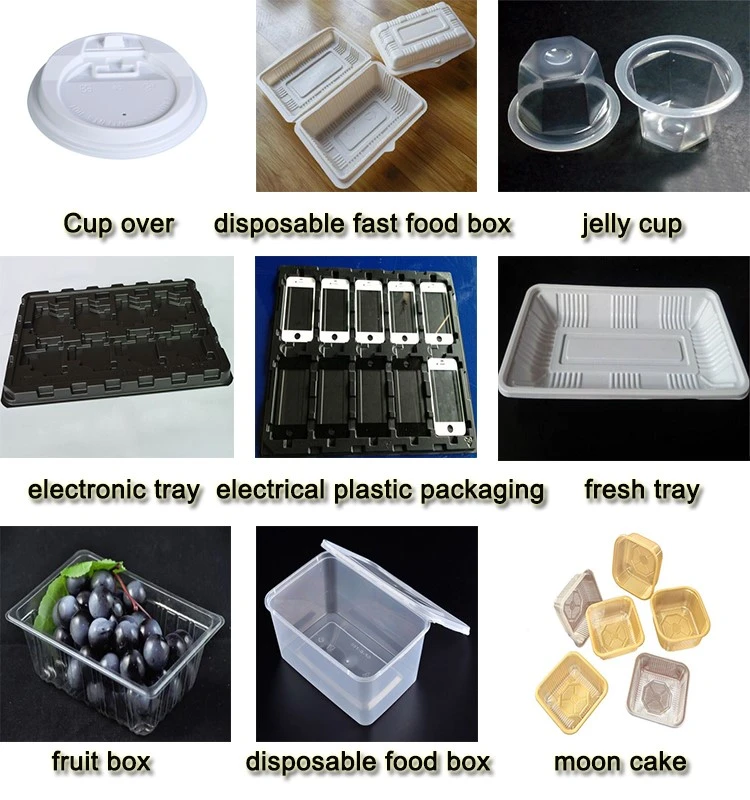
This is particularly relevant to products such as:
Blister packaging
Plastic trays
Disposable food containers
Plastic covers
Foam packaging
Formed plastic components
Honggang manufactures plastic cutting equipment designed for die cutting formed plastic and packaging materials.
For example, Honggang's plastic cutting machines are used for applications including blister packaging, food containers, cup covers, fresh-food trays and fruit boxes.
This creates a practical process connection:
Plastic Sheet → Heating → Forming → Cooling → Die Cutting → Finished Product
The forming stage determines the three-dimensional geometry, while the cutting stage can separate the finished component from the surrounding material.

How to Choose the Right Plastic Processing Equipment
Equipment selection should begin with the product rather than the machine specification.
Before selecting forming or cutting equipment, manufacturers should evaluate:
1. Material
Identify the plastic type and its processing characteristics.
2. Sheet Thickness
Thickness affects heating time, forming behavior, cooling requirements and cutting force.
3. Product Geometry
Deep-draw parts and products with fine surface details may require different forming technologies and mould designs.
4. Production Volume
Prototype, small-batch and high-volume production can require very different equipment configurations.
5. Forming Area
The maximum sheet size and forming area determine the required machine capacity.
6. Automation Level
Automatic feeding, forming, cooling, trimming, stacking and material handling can significantly affect production efficiency.
7. Secondary Cutting Requirements
If the formed plastic must be separated from a surrounding sheet, the die-cutting process should be considered at the equipment-planning stage.
For example, Honggang offers automatic plastic cutting equipment with PLC control and automated feeding configurations for blister and foam packaging applications.
The right solution therefore depends on the complete production process, not simply on choosing a machine with the highest pressure rating.
Pressure Is Only One Part of the Forming Process
The science of plastic forming is ultimately about controlling several variables at the same time.
Pressure provides the driving force, but pressure alone does not guarantee a good part.
A successful forming process requires coordination between:
Material + Temperature + Pressure Difference + Mould + Airflow + Cooling + Cycle Time
Positive pressure forming increases pressure on one side of the heated sheet.
Negative pressure forming, or vacuum forming, reduces pressure on the opposite side.
Both methods use the same fundamental physical concept: a controlled pressure differential moves the softened thermoplastic into the required shape.
Understanding this principle allows manufacturers to make better decisions about material selection, mould design and equipment configuration.
For companies producing formed plastic packaging and components, the forming process should also be considered together with downstream trimming and die cutting.
FAQ About Positive and Negative Pressure in Plastic Forming
What is positive pressure forming?
Positive pressure forming uses compressed air to push a heated thermoplastic sheet against a mould.
What is negative pressure forming?
Negative pressure forming, commonly called vacuum forming, removes air from the mould side of the plastic sheet so that atmospheric pressure pushes the heated sheet toward the mould.
Is vacuum forming the same as negative pressure forming?
In common industrial terminology, vacuum forming is a type of negative-pressure forming because the process creates a pressure reduction on one side of the heated sheet.
Which is better: positive pressure forming or vacuum forming?
Neither process is universally better. The appropriate method depends on the material, product geometry, surface-detail requirements, production volume, mould design and equipment configuration.
What happens after plastic thermoforming?
Depending on the product, the formed sheet may require cooling, trimming, drilling, punching or die cutting before the finished component is ready for assembly or packaging.
Conclusion
Positive and negative pressure are fundamental concepts in plastic forming.
Positive pressure forming uses compressed air to drive the heated sheet toward the mould, while negative pressure forming uses a vacuum to create a pressure differential that draws the material against the mould.
The final result depends on much more than pressure. Temperature control, material behavior, mould geometry, venting, forming depth and cooling all influence the quality and consistency of the finished component.
For industrial manufacturers, understanding these relationships provides a better foundation for selecting the appropriate forming and downstream cutting equipment.
If you are developing a plastic packaging or thermoformed component production process, providing the material type, sheet thickness, product dimensions, mould information and expected production volume allows equipment manufacturers to evaluate the process more accurately.
For plastic die-cutting applications, Honggang provides hydraulic and automatic cutting solutions for blister packaging, plastic products, EPE foam and other non-metallic materials.
Contact Honggang to discuss your plastic forming and die-cutting requirements.