


Receding Head vs. Conveyor Die Cutting Machine: Which Is Right for Your Production?
Choosing an industrial die cutting machine is not simply a matter of comparing cutting force or machine price.
For manufacturers processing leather, fabric, plastic, EPE foam, insulation materials and other flexible materials, the more important questions are how the material is fed, how the cutting area is accessed, how frequently dies are changed, how much manual handling is required, and how the machine will fit into the production line.
Two configurations are particularly relevant for different production requirements: the receding head die cutting machine and the conveyor die cutting machine.
They are designed around different production workflows.
A receding head system is well suited to flexible, operator-assisted production, while a conveyor system places greater emphasis on continuous material feeding and automated material handling.
For an industrial buyer, the right question is therefore not simply which machine is better.
The more useful question is:
Which die cutting system fits your material, production volume, product mix, and automation requirements?
What Is a Receding Head Die Cutting Machine?
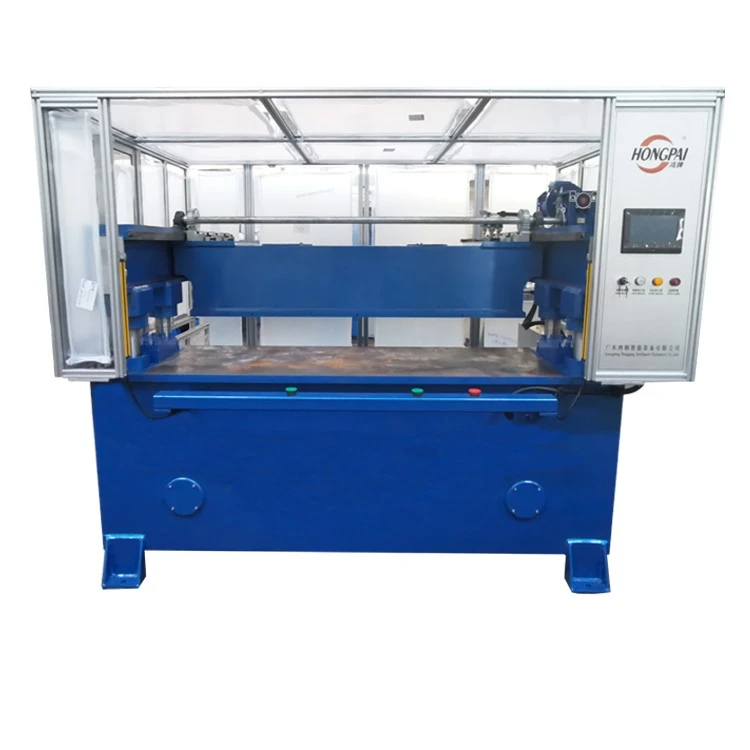
A receding head die cutting machine uses a horizontally moving cutting head.
During a cutting cycle, the head moves into the cutting position, applies pressure to the cutting die, completes the cutting stroke and then retracts.
After the cutting operation, the cutting head moves away from the working area, allowing the operator to continue with the next production step.
This configuration can be useful when the production process still requires manual or semi-automatic material handling.
For example, a manufacturer producing leather components may need to use different cutting dies for different products. Operators may need to position material, change dies, remove finished pieces or inspect the cut parts during production.
In this type of manufacturing environment, flexibility can be more important than achieving the highest possible level of automation.
Honggang Receding Head Die Cutting Machine Specifications
Honggang currently offers receding head die cutting machines in configurations ranging from 40 to 100 tons of cutting force.
The maximum working area can reach 800 × 1400 mm, depending on the machine configuration.
Typical materials include:
Leather
Fabric
Plastic
Other suitable flexible sheet or roll materials
The required machine specification should be selected according to material thickness, die dimensions, production volume and the actual cutting application.
Why Choose a Receding Head Die Cutting Machine?
The main advantage of a receding head die cutting machine is not simply that the cutting head moves backward after the cutting cycle.
The more important point is how the machine fits into the production workflow.
When the head retracts after cutting, the working area becomes accessible for the next operation. This can be useful for factories that process different products, use multiple dies or require regular operator intervention.
A receding head die cutting machine may be considered when a factory has:
Frequent product changes
Multiple cutting dies
Manual or semi-automatic loading
Sheet material production
Different product sizes
Regular product inspection
Flexible production requirements
For manufacturers that do not need a completely automated production line, a receding head configuration can provide a practical balance between machine productivity and operator flexibility.
What Is a Conveyor Die Cutting Machine?
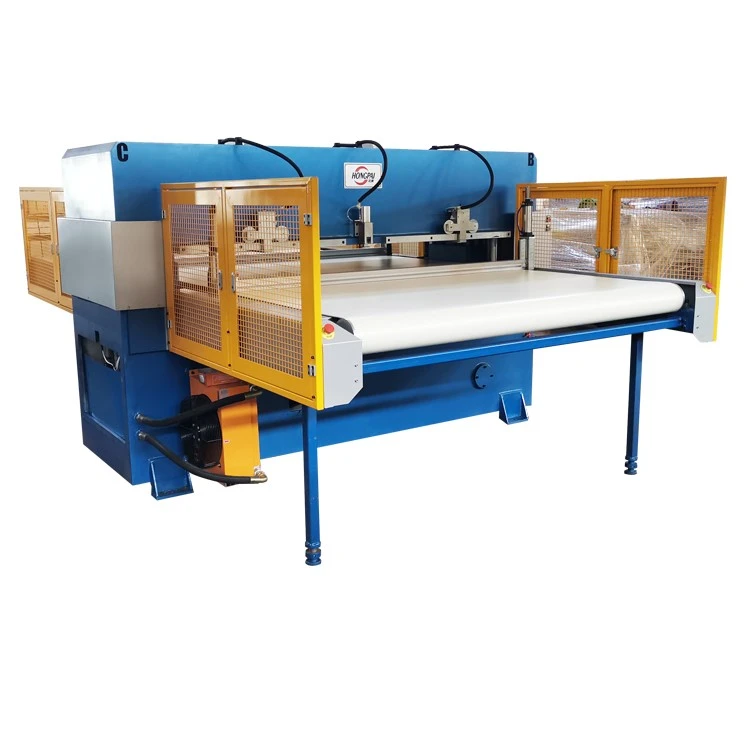
A conveyor die cutting machine integrates material feeding and conveying into the cutting process.
Instead of treating feeding, cutting and material handling as separate operations, the conveyor creates a more continuous flow of material through the production process.
This configuration is particularly useful for large-batch production and applications where continuous feeding is more important than frequent manual repositioning.
Honggang's conveyor die cutting machine range covers approximately 60 to 500 tons of cutting force, with a maximum working area of up to 1000 × 2000 mm, depending on the configuration.
Typical applications include:
EPE foam packaging
Sound insulation foam
Plastic film
Multi-layer linen or burlap-type materials
Fabric
Leather
Carpet
Other suitable non-metal materials
The actual machine configuration should be determined according to the material, die size, production volume and required automation level.
When Does a Conveyor Die Cutting Machine Make More Sense?
The key advantage of a conveyor system is continuous material handling.
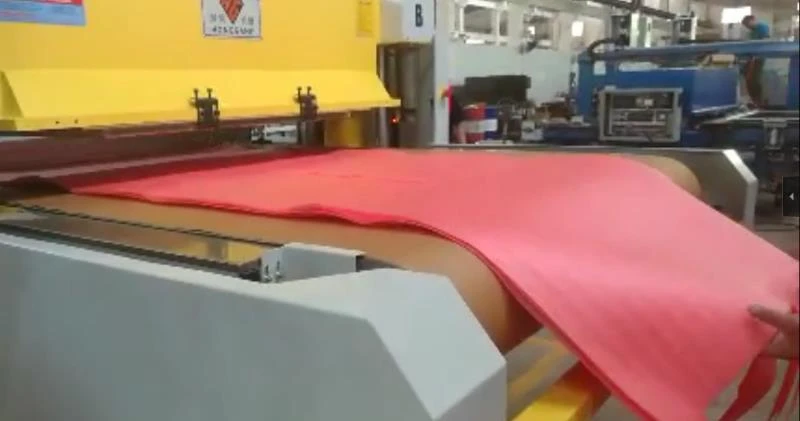
If a factory processes long rolls or large quantities of relatively standardized products, reducing repeated manual feeding and unloading can improve the overall production workflow.
For example, EPE packaging manufacturers may produce large quantities of the same or similar shapes.
Insulation material manufacturers may process continuous rolls or multiple layers.
Plastic film and textile manufacturers may also benefit from controlled feeding and conveying.
In these applications, the conveyor is not simply an additional component.
It becomes part of the material-handling system.
A conveyor die cutting machine may therefore be considered when the production line requires:
Continuous feeding
Large-batch production
Roll material processing
Reduced manual material handling
Servo-controlled feeding
PLC-based production control
Integration with upstream or downstream equipment
However, a conveyor does not automatically make a cutting machine completely unmanned.
The actual automation level depends on the feeding system, positioning method, cutting process, unloading arrangement and other equipment integrated into the production line.
Receding Head vs. Conveyor Die Cutting Machine
The two machine configurations should not simply be viewed as two versions of the same cutting press.
They are designed for different production workflows.
| Factor | Receding Head Die Cutting Machine | Conveyor Die Cutting Machine |
|---|---|---|
| Cutting force | 40–100 tons | 60–500 tons |
| Maximum working area | Up to 800 × 1400 mm | Up to 1000 × 2000 mm |
| Typical materials | Leather, fabric, plastic | EPE foam, insulation materials, plastic film, multi-layer fabric |
| Production style | Flexible/semi-automatic | Continuous / automated |
| Product changes | Suitable for frequent changes | Better for stable, repetitive production |
| Material handling | More operator involvement | More automated |
| Roll materials | Possible with suitable configuration | Particularly suitable |
| High-volume production | Possible | Particularly suitable |
| Automation potential | Medium to high | High |
| Typical application | Flexible production | Continuous large-batch production |
The table is a general engineering comparison. Actual performance depends on material properties, die design, machine specifications and production conditions.
Which Machine Is Better for Leather, Fabric and Plastic?
Leather, fabric and plastic products often involve a relatively high degree of product variation.
A manufacturer may produce different shapes, sizes or product categories using different cutting dies.
In these situations, a receding head die cutting machine can be a practical solution because the production process can accommodate manual or semi-automatic material handling.
For example, a leather goods manufacturer may use different dies for bags, footwear components, automotive interior parts or other products.
The appropriate machine should be selected based on:
Material thickness
Die dimensions
Product size
Required cutting force
Production volume
Feeding method
Honggang's receding head range currently covers 40 to 100 tons, with working areas available up to 800 × 1400 mm.
The actual machine configuration should be confirmed according to the customer's material and production requirements.
Safety: What Should Buyers Check?
Safety is an important part of selecting any industrial die cutting machine.
However, machine safety should not be judged solely by whether the equipment uses a receding head or a conveyor.
A complete cutting machine may incorporate safety systems such as:
Emergency-stop systems
Two-hand controls
Light curtains or presence-sensing devices
Mechanical guarding
Safety interlocks
Controlled access to the cutting area
The operator's workflow is also important.
With a receding head machine, the cutting head retracts after the cutting operation, which can provide access to the working area for the next production step.
With a conveyor system, the interaction between the operator and the feeding, cutting and unloading areas needs to be considered as part of the complete machine design.
For this reason, industrial buyers should request the actual safety configuration from the manufacturer instead of assuming that one machine type is automatically safer than another.
How Much Does a Conveyor Die Cutting Machine Cost?
The price of a conveyor die cutting machine depends on the complete machine configuration.
Important factors may include:
Cutting force
Working area
Conveyor dimensions
Feeding system
Servo system
PLC control
Positioning system
Material handling
Automatic unloading
Safety equipment
Production-line integration
This is why a standard "conveyor die cutting machine price" is difficult to apply to every project.
A machine designed for a small production line and a fully integrated automated cutting line can have very different configurations and costs.
For buyers, it is more useful to compare the complete machine specification and expected production cost rather than comparing the purchase price alone.
Why Choose Honggang for Industrial Die Cutting Equipment?
Guangdong Honggang Intelligent Equipment Co., Ltd. manufactures industrial die cutting equipment under the Honggang brand.
The company's product range includes receding head die cutting machines, conveyor die cutting machines and other industrial cutting equipment.
Honggang has more than 20 years of experience in the related manufacturing field, according to the company's published product information.
For international buyers, working directly with an equipment manufacturer can make it easier to discuss machine configuration around the actual production application.
Instead of selecting equipment based only on tonnage, buyers can provide:
Material + thickness + product size + die dimensions + production volume
and discuss the appropriate machine configuration with the engineering team.
Receding Head or Conveyor: Which One Should You Choose?
The choice should start with the production process rather than the machine name.
A receding head die cutting machine may be suitable when your factory needs:
Flexible production
Frequent product changes
Frequent die changes
Manual or semi-automatic operation
Processing of leather, fabric or plastic
Operator access to the cutting area
A conveyor die cutting machine may be suitable when your factory needs:
Continuous feeding
Large-batch production
Roll material processing
Reduced manual material handling
Higher automation
Processing of EPE foam, insulation materials or plastic film
Honggang's current machine range covers both production approaches:
Receding Head: 40–100 tons, up to 800 × 1400 mm.
Conveyor: 60–500 tons, up to 1000 × 2000 mm.
The final selection should be based on the actual material, die dimensions, production volume, feeding method and automation requirements.
There is no single machine configuration that is suitable for every production line.